If you are drawn to wide-open land in Northern New Mexico, acreage can feel like the ultimate freedom. It can also come with more moving parts than a typical in-town purchase, especially when you are comparing places as different as Arroyo Hondo near Taos and Seton Village near Santa Fe. This guide will help you understand the practical questions that matter most, from water and septic to access, drainage, and valuation, so you can move forward with more confidence. Let’s dive in.
Why This Comparison Matters
Arroyo Hondo and Seton Village may both appeal to buyers looking for space, scenery, and a more rural setting, but they sit in different county environments and should not be treated as the same submarket. Arroyo Hondo is a Taos County census-designated place, while Seton Village is a Santa Fe County census-designated place about six miles southeast of Santa Fe. The U.S. Census reference for New Mexico census-designated places also places Seton Village in the Santa Fe-area context.
That distinction matters because county rules, development standards, and site constraints can shape your buying process. If you are shopping acreage in either area, the right question is not just how many acres you are getting. It is whether the land supports the way you want to use it.
Start With Land Use Basics
When you buy acreage, the land itself often drives value more than a house-style comparison would on a typical neighborhood lot. In rural settings, usable land, topography, access, water, and septic feasibility can all affect how a property functions and how it appraises.
According to Appraisal Institute guidance on rural valuation, rural appraisals often rely on land mix, improvement value extraction, and the best available data in markets with fewer comparable sales. Fannie Mae guidance cited in the research also notes that rural appraisals can involve limited sales data, meaningful location differences, and environmental factors that affect value or marketability.
In practical terms, two parcels with the same acreage count can offer very different ownership experiences. One may have straightforward access, a documented well, and a workable homesite. Another may look appealing at first glance but require extra investigation before you know what is truly buildable or usable.
Water Questions Come First
Understand Well Permits
In New Mexico, water is not a detail to sort out later. The New Mexico Office of the State Engineer says anyone wanting to use water in the state must have a permit from the State Engineer, and a permit to drill is required before drilling a well.
The agency also explains that domestic use can include household use, non-commercial watering of domesticated animals, and irrigation of non-commercial lawn, garden, trees, or landscaping up to one acre. If you are considering acreage for a specific lifestyle use, that definition is important because it helps frame what a domestic well may and may not cover.
Ask for the Right Well Records
Before closing, ask for documentation early. The State Engineer’s well guidance says buyers should keep the well log, maintenance receipts, pump receipts, water-quality tests, and water-level measurements.
This is one of the most important parts of acreage due diligence. A parcel with an existing well may still require careful review of condition, history, and documentation. If the well is not on land owned by the seller, written authorization can also matter, and only licensed well drillers may drill wells under state guidance.
Septic Needs Early Attention
Know the Transfer Requirement
For many rural properties, onsite wastewater is just as important as water supply. The New Mexico Environment Department Environmental Health Bureau regulates septic systems and provides permitting and technical assistance.
For property transfers, NMED states that an established onsite liquid waste system must be evaluated before transfer, and that evaluation becomes part of the official record. That means septic is not just a casual inspection item. It can be a formal part of the transaction timeline.
Watch for Missing Records
NMED’s property transfer evaluation guidance is especially useful because missing permit history can delay closing. If you are serious about an acreage purchase, confirm septic permit records and transfer-evaluation requirements as early as possible.
Permit guidance may also require proof of ownership, a site diagram showing structures, wells, boundaries, and setbacks, plus plot-plan and soils, geologic, or hydrologic information. On some systems, advanced treatment equipment can require a maintenance and sampling contract. In other words, not every septic setup carries the same long-term responsibility.
Legal Access Is More Important Than It Sounds
A beautiful parcel is only as practical as its access. In Taos County, special-use materials require adequate legal access from a public road, and no access road or driveway should exceed a 12 percent grade under those materials. You can review that framework in the county’s special-use permit materials.
Santa Fe County takes a similar approach. Its land development code says every lot must have ingress and egress to a public or private road network.
For buyers, this means you should verify more than whether a driveway exists. Confirm whether access is legal, whether any easements are recorded, and who is responsible for maintaining a shared or private road. This becomes especially important on parcels with long driveways or informal-looking access routes.
Drainage, Arroyos, and Floodplain Review
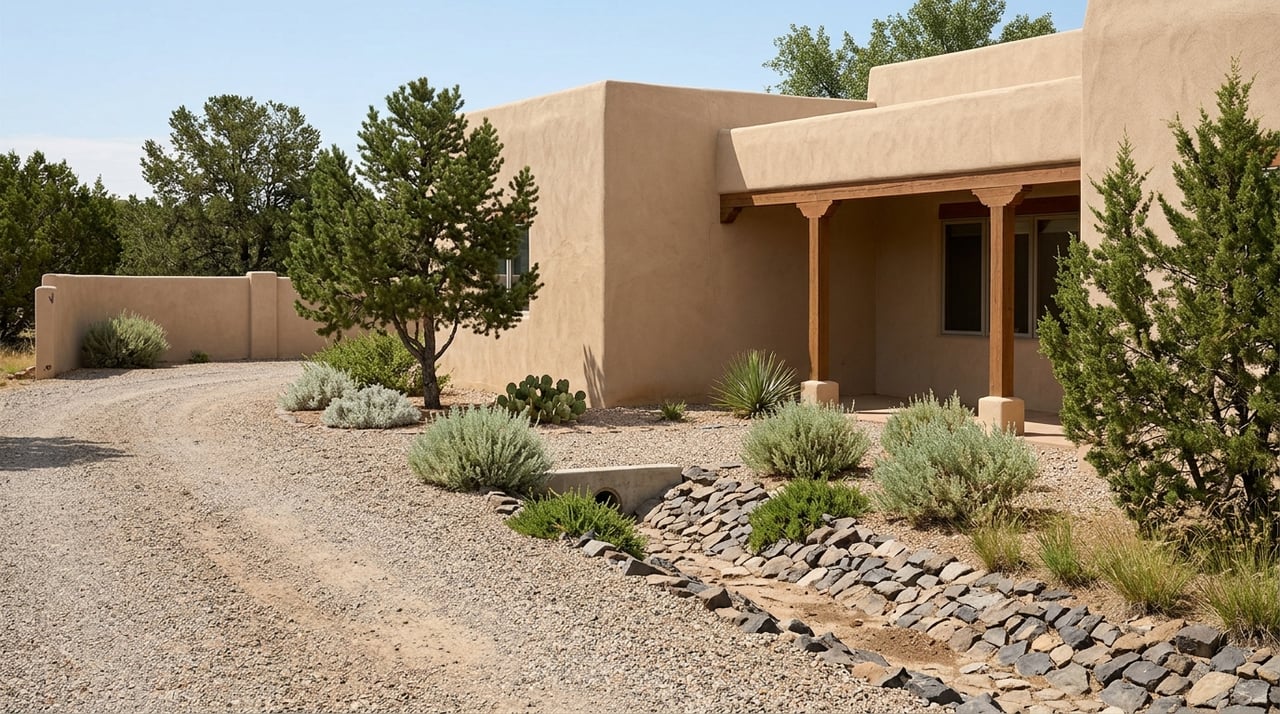
In high-desert landscapes, water flow patterns matter even on land that looks dry most of the year. Taos County’s materials say runoff must be contained on site, and development on or near acequias must be reviewed by the acequia commission. The same materials note that acequias must remain open and accessible unless permission says otherwise.
Taos County also states on its floodplain management page that local construction in a floodplain is regulated using FEMA and EPA standards. If a parcel includes low areas, arroyos, or drainage paths, you will want to understand those constraints before relying on a conceptual building site, barn placement, or livestock layout.
In Santa Fe County, the land development code adds that a drainage right-of-way is required where a subdivision is crossed by a watercourse. The county also says walls or fences that cross a stream, existing trail, arroyo, acequia, or drainage channel need a permit. These are the kinds of details that can affect how you plan and enjoy a property over time.
Trail and Equestrian Access Should Be Verified
Acreage buyers are often drawn to outdoor use, including riding, walking, or broader trail connectivity. That appeal is real, but it is smart to separate informal use from recorded rights.
Taos County’s special-use materials say street and parking design should consider equestrians and pedestrians. In Santa Fe County, trail easements are required when a recognized trail crosses a subdivision.
If a property is marketed around equestrian or trail access, verify that access in writing. The Santa Fe County code supports the idea that recognized trails and legal ingress or egress need to be treated formally, not assumed from a seller’s description or a worn path on the ground.
Arroyo Hondo vs. Seton Village
Arroyo Hondo Considerations
Arroyo Hondo buyers are typically looking at land within Taos County’s framework, where access, driveway grade, runoff control, acequia review, floodplain conditions, and wildland-urban-interface issues may all matter. For a buyer, that means parcel-specific due diligence should happen early, especially if the land is irregular, crossed by drainage, or served by a long driveway.
Because rural valuation often depends heavily on utility and usability, the most attractive acreage is not always the parcel with the biggest number on paper. It is often the parcel with clearer legal access, fewer infrastructure unknowns, and a site plan that aligns with your intended use.
Seton Village Considerations
Seton Village sits in Santa Fe County and should be approached as a Santa Fe-area acreage option rather than part of the Taos submarket. The Census source used in the research places it in that county context, and the Library of Congress description referenced in the research identifies Seton Village as one of the first artists' colonies in the Santa Fe area.
For buyers, Santa Fe County’s code brings its own review points, including ingress and egress, drainage corridors, and trail easements where recognized trails cross a subdivision. If you are looking for land with a more Santa Fe-oriented lifestyle connection, these land-use details are still essential to confirm before you make assumptions about development or access.
A Smart Acreage Due Diligence Checklist
Before you commit to acreage in Arroyo Hondo or Seton Village, focus on the items that most often shape feasibility and long-term ownership:
- Confirm the well permit and review the well log, maintenance records, pump receipts, water-quality tests, and water-level information.
- Confirm septic permit history and ask about the required transfer evaluation early.
- Verify legal access, recorded easements, and road maintenance responsibility.
- Review floodplain, arroyo, acequia, and drainage conditions before finalizing your site assumptions.
- If outdoor or equestrian access matters to you, verify that trail access is recorded and county-recognized rather than informal.
- Ask how the parcel’s topography and infrastructure may affect appraisal support in a limited-sales rural market.
Why Guidance Matters on Acreage Purchases
Buying acreage is often as much about interpretation as it is about inventory. Records, permits, access, and site constraints can all influence whether a parcel is truly a fit for your goals. That is why a calm, local, detail-oriented approach matters.
If you are comparing Northern New Mexico acreage and want a more curated path through the process, The Agency Santa Fe can help you evaluate property details, ask sharper due diligence questions, and move forward with greater clarity.